Five Sentences by the Cup: Write Your Own Small Mystery
A familiar coffee, one ordinary object, and a small change are enough to begin a story of your own.
Choose Ali Chalmer Roast for your next writing pause. Prepare the coffee you already enjoy, open a notebook, and give yourself a deliberately small task: five sentences, not a novel. You do not need a new pen, a distant cabin, or a perfectly quiet morning. You need an ordinary object and one detail that makes it seem less ordinary than it was a moment ago.
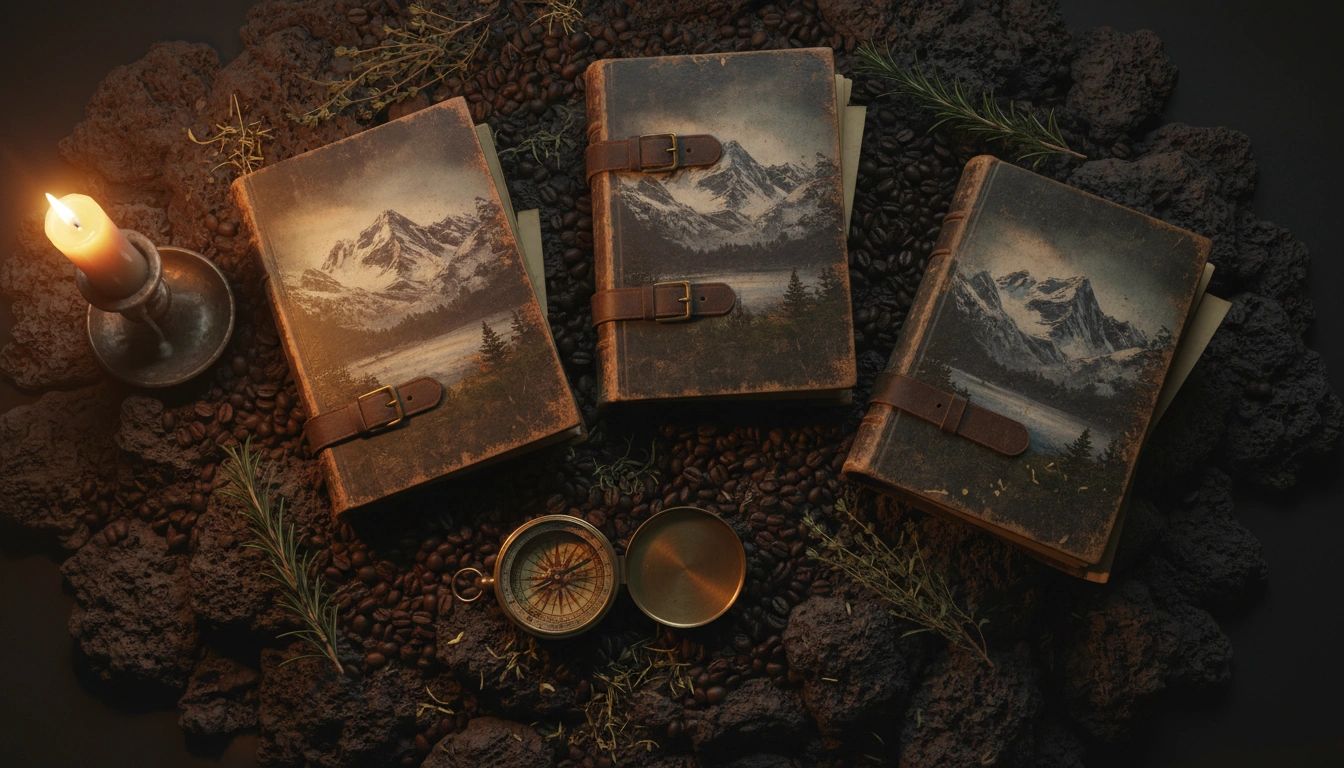
The atmosphere of Ali Chalmer offers a starting mood: a threshold, a road not yet taken, something left unsaid. Borrow that sense of possibility, not a published scene or a character's biography. Your exercise can belong entirely to you. The example below is original fiction created for this journal, not an excerpt or an event from the books.
Make the coffee familiar, not another assignment
Use your usual preparation method and a serving you expect to enjoy. The coffee is company for the exercise, not something you must evaluate while inventing a plot. Keep the cup on a stable surface away from your notebook or keyboard. If it is too hot to drink comfortably, let it cool while you choose your first object.
Leave brewing experiments for another day. If you are still working out your recipe, our grind-size guide is a separate place to start. For this pause, finishing a small piece of writing matters more than making several decisions about the cup at once. There is no requirement to finish the drink before you finish the story.
Choose something you can describe without explanation
Look for a key, an envelope, a button, a ticket, or a folded map. Pick one. Write down two things a person could notice about it: a bent corner, a faded number, an unfamiliar stain. Avoid beginning with the object's entire history. A reader needs something to see before being asked to understand what it means.
Give the object a setting with a clear edge: a doorway, a counter, a bench, a window ledge. Then decide who notices it. A first-person narrator is useful because you can write in everyday language, but the voice does not have to sound like you. Keep real people's private experiences out of the exercise; an invented situation gives you room to play.
Give each sentence one job
- Place: show where the narrator is and what they expect.
- Object: introduce the thing that catches their attention.
- Change: reveal one detail that does not fit.
- Choice: make the narrator do something because of it.
- Aftermath: leave a consequence or a question, rather than explaining everything.
These are working constraints, not rules for all fiction. Five short sentences can carry more movement than five crowded ones. If a line contains a whole paragraph's worth of explanation, choose its most useful action and save the rest for a different draft.
Try a mystery small enough to hold in one hand
I waited at the station counter for the clerk to return.
Beside the bell lay a ticket with tomorrow's date.
On its back, someone had written the name I had stopped using years ago.
I turned it over before the clerk could see.
From the other side of the closed shutter, he asked whether I wanted the same seat again.
The ticket gives the scene something visible. The old name changes its meaning. Turning it over is a choice, and the final question makes that choice uncomfortable. We do not need to explain the station's history or decide whether anything supernatural has happened. Those possibilities can remain open.
Read once, change one thing, then stop
Read your five sentences aloud if your setting allows it. Ask whether the reader can follow the movement from noticing to choosing. Replace one vague word with a concrete detail, or remove an explanation the scene already suggests. Resist adding a sixth sentence just to solve every uncertainty. Date the page and let this version exist.
You can keep it private or share it with someone who wants to read it. Ask one useful question: “Which detail stayed with you?” For another kind of journey, explore Books & Lore. Your five sentences do not need to become a book. A cup, a small mystery, and a finished page are enough for today.
Begin Your Own Page